
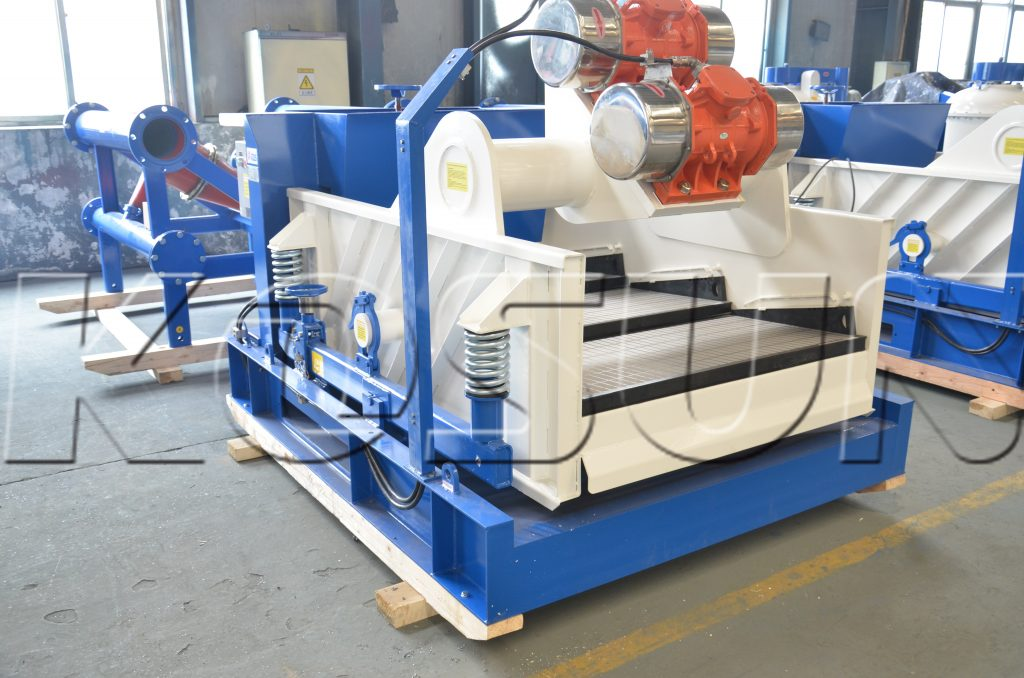
The drilling fluid vibrating screen occupies a unique position in the mud control system. Positioned at the very front of the process, it handles solid-liquid separation earlier, faster, and more economically than any downstream equipment. Its working efficiency effectively sets the processing ceiling for the entire system. Because of this, identifying what drives — or limits — screen performance is essential for any drilling operation. Three factors dominate: vibration mode, amplitude and frequency, and screen mesh characteristics. KOSUN provides high-performance vibrating screens engineered to maximize efficiency across all three dimensions.
Factor One: Vibration Mode
Vibration mode shapes how solids travel across the screen surface. Vibrating screens generally operate in one of three patterns: linear, circular, or elliptical motion. The deciding variable is where the vibrator’s center of gravity sits.
Within the vibrator: The screen produces circular motion.
Above the vibrator: The screen generates elliptical motion, which depends on screen slope to move cuttings — a design that trades processing capacity for conveyance.
Above and slightly forward: The screen delivers linear motion, sustaining a consistent conveying speed.
In practice, linear motion has become the standard for most drilling operations because it balances conveyance and capacity effectively.
Factor Two: Amplitude and Frequency
Amplitude and frequency together control how aggressively the screen processes fluid. Frequency rises and falls with motor speed, and higher frequencies generally improve solid-phase separation. High-frequency vibrating screens, for instance, commonly operate at roughly 2,000 vibrations per minute.
Amplitude describes the vertical travel of the screen, set by vibration mass and eccentricity. Increasing amplitude can strengthen processing performance — but it also raises mechanical stress on the equipment, which can shorten service life. Consequently, operators must weigh separation performance against long-term durability.
Factor Three: Screen Mesh and Material
Screen mesh and material form the final performance layer. Most shale vibrating screens carry 2 to 4 screen layers, with drilling fluid flowing through each in sequence for staged classification.
Choosing the wrong mesh size — or operating with damaged screens — sharply reduces separation efficiency. Faulty installation can also cause premature wear or tearing. For these reasons, correct screen material selection and proper installation are both essential to continuous, reliable operation.
The KOSUN Advantage
KOSUN vibrating screens bring clear strengths to oil drilling applications. Their modular design and high-precision manufacturing ensure smooth, dependable operation. Multiple adjustable vibration modes allow adaptation to different formations and drilling requirements. High-quality motors and shock absorption systems sustain high-frequency screening efficiency while extending equipment life. Finally, high-strength composite screen mesh materials combined with sound structural design significantly boost screen durability and processing efficiency — delivering an economical, all-around solids control solution.
Conclusion
Understanding vibration mode, amplitude and frequency, and screen mesh characteristics gives operators the tools to select and fine-tune their drilling fluid vibrating screen for peak efficiency. The right screen translates into better solids removal, longer equipment life, and reduced drilling costs. KOSUN is committed to providing high-performance vibrating screens and expert support to help customers achieve their operational goals.