
Every drilling rig depends on a continuous loop of drilling fluid moving from surface to bottom hole and back again. At the center of that loop sits the mud tank, a piece of equipment that often goes unnoticed but quietly makes the entire operation possible. From storing thousands of cubic metres of fluid to separating out damaging solids and stabilising pressure across the system, the mud tank carries responsibilities that directly affect drilling safety and efficiency. KOSUN manufactures high-performance mud tanks built for reliable service in every drilling environment.
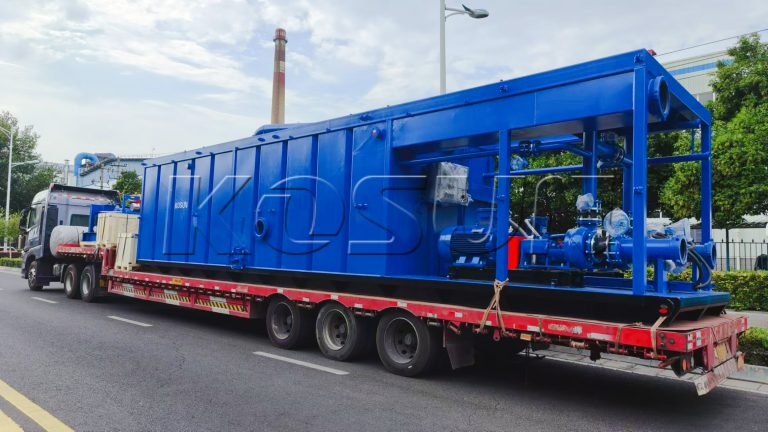
What Goes Into a Mud Tank?
A modern mud tank is more than a steel container. It combines a tank body, mixing mechanism, level monitoring system, flow pipelines, and interconnecting fittings into one integrated unit.
The tank body itself is welded from heavy steel plate, engineered to withstand continuous service. Inside, the mixing mechanism keeps solids from settling to the bottom. The level monitoring system tracks fluid height in real time, protecting against overflow on one end and pump starvation on the other. Together, these elements create a system that performs reliably around the clock.
How the Mud Tank Functions
Fluid Storage: The tank holds a stable reserve of drilling fluid, allowing operations to continue without interruption.
Fluid Circulation: Pumps pull mud from the tank and send it downhole; the returning stream carries cuttings back to complete the cycle.
Solids Removal: Vibrating screens, desanders, and desilters installed on the tank strip out cuttings and finer particles, raising mud purity.
Fluid Conditioning: Operators introduce chemical treatment agents to adjust viscosity, density, and other properties according to formation requirements.
Level Management: Sensors monitor mud height and control pump activity to keep levels steady.
Four Critical Roles of the Mud Tank
- Storage Capacity That Keeps Drilling Moving
The mud tank’s most fundamental job is holding enough drilling fluid to sustain continuous operations. In ultra-deep wells, that can mean storage capacity measured in thousands of cubic metres.
Beyond routine supply, the tank also acts as an emergency reserve. When a well surge or leak occurs, stored fluid can be deployed immediately to bring downhole conditions under control.
- Purification That Protects Equipment
As drilling fluid circulates, it collects rock cuttings. Left in the system, those solids cause equipment damage. Working alongside vibrating screens, desanders, and desilters, the mud tank helps separate solids effectively, extending both fluid performance and equipment service life.
Harmful gases present a second purification challenge. Hydrogen sulphide (H₂S) and methane (CH₄) can dissolve into the fluid, creating safety hazards. Mud tanks address this with gas discharge devices such as breathing valves. More advanced designs incorporate degassers for an added layer of protection.
- Blending That Matches Formation Conditions
Drilling fluid properties must be adjusted as formations change. Adding barite increases density, for example, while chemical treatments modify viscosity. Through accurate mixing within the mud tank, operators ensure the fluid meets the demands of each drilling stage.
- Stability That Holds the System Together
The mud tank buffers the pressure and flow fluctuations that naturally occur during drilling. When pump output climbs, the tank absorbs the excess fluid; when output drops, it releases stored fluid to fill the gap. This buffering protects equipment and keeps circulation steady.
The tank also serves as the connecting hub between vibrating screens, desanders, desilters, and mud pumps. By linking these components, it maintains orderly flow and keeps every piece of equipment working in harmony.
Conclusion
Mud tanks are far more than storage vessels, they are the backbone of the drilling fluid circulation system. By providing reliable storage, removing solids and harmful gases, enabling precise blending, and stabilising system pressure, they contribute directly to safe and efficient drilling. KOSUN is committed to delivering high-performance mud tanks and expert support to help customers achieve their operational goals.