
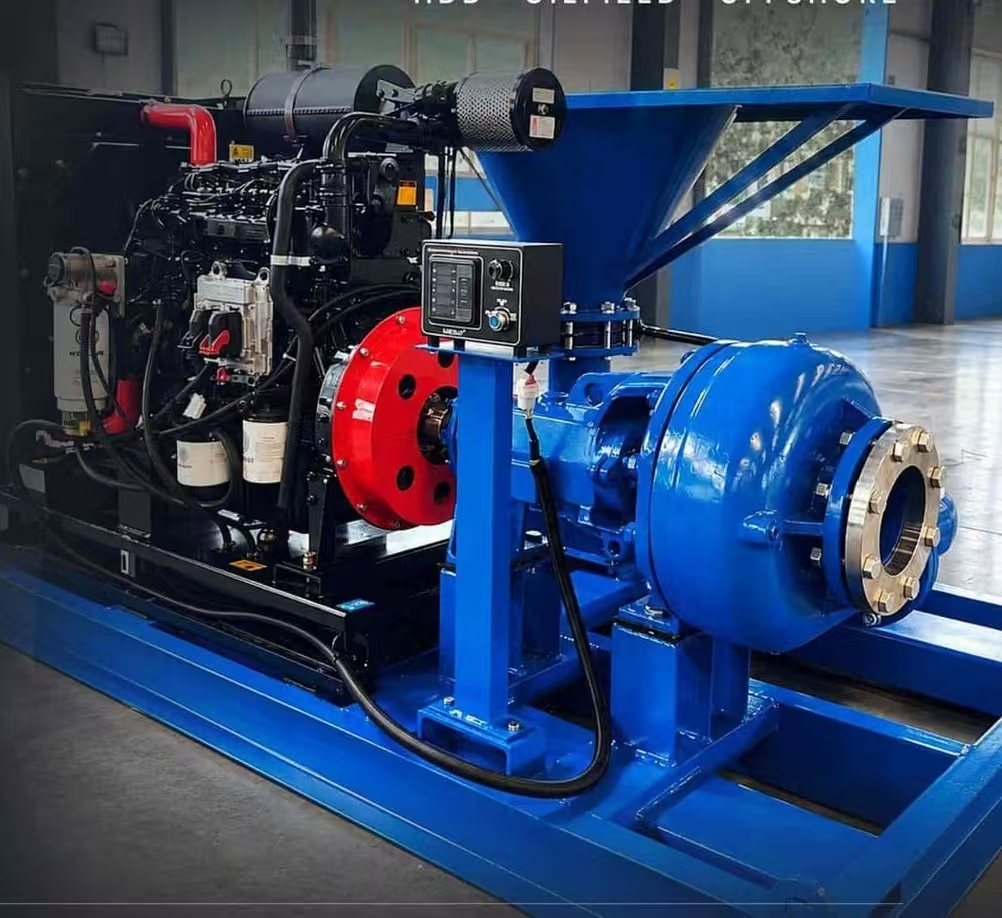
Diesel driven mud mixing equipment helps HDD contractors prepare drilling fluid at sites where a separate power source is needed. KOSUN’s unit integrates a diesel engine, a centrifugal pump, and a Venturi mixing hopper into a single skid-mounted package — bringing the key mixing and pumping components together for field use.
For horizontal directional drilling crews, that integration matters. Drilling fluid supports the borehole and carries cuttings out of the hole, so proper fluid preparation plays an important role in daily site operations. When power access is uncertain, a self-contained mixing unit removes one variable from the equation.
Supporting Drilling Fluid Preparation
During horizontal directional drilling (HDD), drilling fluid performs two essential jobs: it supports the borehole wall and transports cuttings back to the surface. Because the fluid does so much of the work, its preparation deserves attention every day on site.
The diesel engine drives the centrifugal pump , which supplies fluid to the Venturi mixing hopper. Operators then add bentonite and other suitable additives to prepare the drilling fluid. The exact process depends on the fluid recipe and project requirements.
The Venturi design is central to how this works. As fluid passes through the hopper at high velocity, it creates a vacuum that draws in dry additives and disperses them into the fluid stream. This produces a more uniform mixture than simple agitation alone.
Why Consider a Diesel-Driven Unit?
Some drilling sites have limited access to a suitable electrical supply. In these cases, a diesel-driven unit provides an alternative power option for mixing and pumping tasks — one that does not depend on the local grid or on temporary power arrangements.
This is particularly relevant for HDD work, which often takes place where infrastructure is minimal: rural pipeline routes, remote river crossings, or urban sites where temporary power connections are impractical. A diesel-driven unit keeps fluid preparation running regardless of what the site offers.
Moreover, the skid-mounted design groups the main components into one unit. This helps contractors plan equipment placement and arrange the mud handling area more easily, since the mixing system arrives as a single package. A compact footprint also simplifies relocation between job sites.
That said, contractors should still check available space, required flow rate, and site conditions before selecting a configuration.
Match the Equipment to the Project
Every HDD project has its own drilling conditions and fluid needs, and the mixing equipment should follow from those conditions rather than from a generic specification sheet.
Contractors should consider:
- Planned bore length: longer bores generally require larger fluid volumes and more continuous mixing
- Soil conditions: sand, gravel, clay, and rock each call for different fluid properties
- Drilling fluid volume: the total volume in circulation shapes the required mixing capacity
- Equipment already available on site: the mixing unit should complement existing assets rather than duplicate them
They should also review how the mixing unit will work with mud tanks, pumps, and other parts of the mud system. With these details in mind, contractors can choose a setup that better fits their field operations.
Explore KOSUN Mud Mixing Solutions
KOSUN offers equipment for drilling fluid preparation and related field applications. The diesel-driven mixing skid is one option within a broader range of solids control and mud handling equipment.
Contact the team to discuss your project requirements and find a suitable equipment configuration.
Conclusion
Diesel driven mud mixing equipment gives HDD contractors a practical way to prepare drilling fluid where reliable electrical power is not available. By combining a diesel engine, centrifugal pump, and Venturi mixing hopper on a single skid, KOSUN’s unit simplifies equipment planning while supporting consistent fluid preparation. Matching the unit to your project’s bore length, soil conditions, fluid volume, and existing equipment ensures it contributes to the operation rather than complicating it.